Author: David M Masters

Branding Masters Remastered 13-Week Course

Build a Brand of Integrity, Strength, and Legacy with David M Masters
A Personal Invitation from David M Masters

For years, I’ve sat across from leaders, entrepreneurs, visionaries, and everyday people with extraordinary dreams. Many had logos, websites, and marketing plans, but they still asked me the same question:

“Why doesn’t my brand feel alive?”

The truth is, most branding advice out there focuses on polish. Fonts, colors, taglines. But what really endures, what really builds loyalty, trust, and legacy, is far deeper.

Your brand isn’t what you say it is. It’s what others experience when they encounter you. It’s the story they tell about you when you’re not in the room.

That’s why I created the Branding Masters Remastered 13-Week Course to guide you step by step, not only in crafting a powerful brand strategy, but in creating a brand that is rooted in your values, aligned with your calling, and designed to endure long after trends fade.

This course is not just information. It’s transformation. Together, we’ll do the deep work of aligning your message, voice, and actions with your higher purpose, so your brand becomes more than a business. It becomes your legacy.

Who This Course Is For

This course is for:

  • Entrepreneurs who want to stand out with more than clever marketing.
  • Coaches, consultants, and leaders who need to connect with trust and authenticity.
  • Creative professionals and nonprofits who want to build influence that lasts.
  • Anyone with a mission or message who knows their brand must be more than a logo.

If you’ve ever felt like your brand doesn’t fully capture who you are, or like you’re stuck between hype and hesitation, this course was built for you.

What Makes This Course Different

Most branding programs teach you how to look good on the outside.
Branding Masters Remastered will teach you how to be unforgettable on the inside.

  • Integrity at the Core. You’ll learn how to align your brand with your deepest values, so you never have to fake it or force it.
  • Practical + Spiritual Fusion. Each week blends actionable strategies with the deeper mindset and spiritual dimension of branding.
  • Legacy Focus. Beyond quick wins, you’ll build something that outlasts markets, fads, and even you.
  • Direct Access to the Author. This isn’t taught by a staffer or assistant. You’ll be mentored live by me, David M Masters, as we walk through the framework together.
The 13-Week Journey

Here’s what we’ll cover, week by week:

Module 1: What Is a Brand, Really?

Discover the living definition of a brand, not a logo, not a tagline, but the story others tell about you. Learn how to uncover your current brand reality and set the foundation for transformation.

Module 2: The Branding Masters’ Code

Explore the five unshakable principles that separate enduring brands from those that collapse. This becomes your compass for every decision.

Module 3: Finding Your Authentic Voice

Your voice is not a marketing trick, it’s the bridge between your truth and your audience. Learn to speak with clarity, courage, and resonance.

Module 4: Crafting Your Brand Promise

Go beyond slogans. Build a promise that your people can feel, trust, and repeat, something that can stand for generations.

Module 5: Building Trust Through Consistency

Trust is the currency of every brand. Learn how to keep your word, repair broken promises, and become known as reliable in all seasons.

Module 6: Living Your Brand Values

Your values are more than a poster on the wall. Learn to embody them in daily decisions so your brand breathes integrity.

Module 7: Emotional Connection: The Heart of Loyalty

People may respect your skill, but they will stay for how you make them feel. Learn the art of emotional connection that turns clients into advocates.

Module 8: Collaboration and Community

Your brand grows stronger when it’s not a solo act. Discover how to build partnerships, networks, and tribes that amplify your reach.

Module 9: Building Endurance

Most brands fail in the middle. Learn the practices that create resilience and allow you to build trust that compounds over decades.

Module 10: Evolution Without Drift

How do you stay fresh without losing your soul? This module shows you how to adapt with integrity, ensuring growth without compromise.

Module 11: The Spiritual Dimension of Branding

Branding is not just business, it’s calling. Discover how alignment with your higher purpose fuels authenticity and legacy.

Module 12: Legacy in Action

Legacy is more than memory; it’s multiplication. Learn how to build influence that will outlive you.

Module 13: Integration & The Journey Forward

Pull everything together into your Brand Master Plan. Leave with a living roadmap for your brand, built on integrity, strength, and legacy.
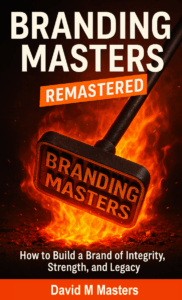
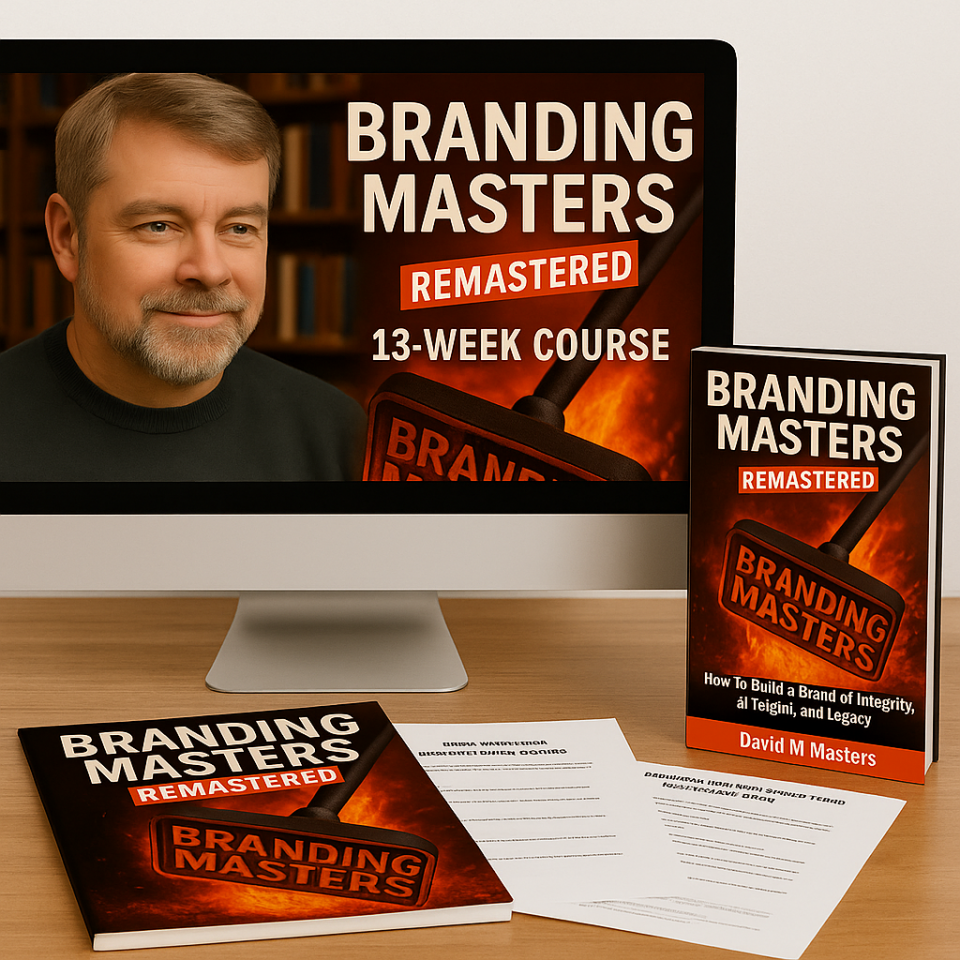
Branding Masters Remastered Textbook

What You’ll Gain

By the end of the 13 weeks, you will have:

  • A clear, compelling brand promise you can stand on with integrity.
  • A voice that resonates authentically with your audience.
  • A set of brand values lived out daily, not just written down.
  • A strategy for trust, loyalty, and emotional connection.
  • Tools to evolve without losing your essence.
  • A plan for building a brand legacy that endures for generations.

More importantly, you’ll leave this course not just with strategies, but with alignment. You’ll know who you are, what you stand for, and how to embody that in a way people can see, feel, and trust.

Course Format

  • 13 Weeks of Live Teaching with David M Masters
  • Interactive Coaching & Q&A each session
  • Worksheets & Reflection Exercises to apply the lessons directly
  • Community Forum to connect with like-minded leaders
  • Lifetime Access to Recordings so you can revisit anytime

Enrollment & Investment

The regular investment for this course is $3,497.

Today, you can enroll for just $2,497 when you sign up now. That’s $1,000 in savings, available for a limited time.

Spaces are limited to keep the course personal and interactive.

👉 [Reserve Your Spot Now]

What People Say

“David doesn’t just teach branding. He lives it. This course helped me align my business with my soul. For the first time, I feel like I’m not just selling—I’m serving.”
— Rachel, Coach & Author

“The shift was immediate. My clients noticed, my team noticed, and most importantly, I noticed. I no longer feel split between my values and my work. This course gave me integration.”
— Mark, Entrepreneur

Your Legacy Begins Here

One day, people will tell stories about your work. The only question is—what will those stories be?

If you are ready to build a brand of integrity, strength, and legacy—a brand that doesn’t just shine for a season but stands for generations—this is your invitation.

Sign up today, save $1,000, and step into your journey as a true Branding Master Remastered.

👉 [Enroll Now for $2,497]
 

Choose Your Business Structure

There are different kinds of business structures, you must choose the one that is right for you.

Sole proprietorship

A sole proprietorship is easy to form and gives you complete control of your business. You’re automatically considered to be a sole proprietorship if you do business activities but don’t register as any other kind of business. 

Sole proprietorships do not produce a separate business entity. This means your business assets and liabilities are not separate from your personal assets and liabilities. You can be held personally liable for the debts and obligations of the business. Sole proprietors are still able to get a trade name. It can also be hard to raise money because you can’t sell stock, and banks are hesitant to lend to sole proprietorships.

Sole proprietorships can be a good choice for low-risk businesses and owners who want to test their business idea before forming a more formal business.

Partnership

Partnerships are the simplest structure for two or more people to own a business together. Individuals may create a partnership by oral or written agreement. In a General Partnership, the partners share personal liability for all claims against the partnership, as well as share all profits and losses. Profits are taxed as personal income for each individual partner.

There are three common kinds of limited partnerships (LP) limited liability partnerships (LLP) and limited liability limited partnership (LLLP).

Limited partnerships have only one general partner with unlimited liability, and all other partners have limited liability. The partners with limited liability also tend to have limited control over the company, which is documented in a partnership agreement. Profits are passed through to personal tax returns, and the general partner — the partner without limited liability — must also pay self-employment taxes.

Limited liability partnerships are similar to limited partnerships, but give limited liability to every owner. An LLP protects each partner from debts against the partnership, they won’t be responsible for the actions of other partners.

A Limited Liability Limited Partnership is a Limited Partnership that chooses to become an LLLP by including a statement to that effect in its certificate of limited partnership. This type of business structure may shield general partners from liability for obligations of the LLLP. Filing with your state may be required.

Partnerships can be a good choice for businesses with multiple owners, professional groups (like attorneys), and groups who want to test their business idea before forming a more formal business.

Limited liability company (LLC)

An LLC lets you take advantage of the benefits of both the corporation and partnership business structures.

LLCs protect you from personal liability in most instances, your personal assets — like your vehicle, house, and savings accounts — won’t be at risk in case your LLC faces bankruptcy or lawsuits.

Profits and losses can get passed through to your personal income without facing corporate taxes. However, members of an LLC are considered self-employed and must pay self-employment tax contributions towards Medicare and Social Security.

LLCs can have a limited life in many states. When a member joins or leaves an LLC, some states may require the LLC to be dissolved and re-formed with new membership — unless there’s already an agreement in place within the LLC for buying, selling, and transferring ownership.

LLCs can be a good choice for medium- or higher-risk businesses, owners with significant personal assets they want to be protected, and owners who want to pay a lower tax rate than they would with a corporation.

Corporation

C corp

A corporation, sometimes called a C corp, is a legal entity that’s separate from its owners. Corporations can make a profit, be taxed, and can be held legally liable.

Corporations offer the strongest protection to its owners from personal liability, but the cost to form a corporation is higher than other structures. Corporations also require more extensive record-keeping, operational processes, and reporting.

Unlike sole proprietors, partnerships, and LLCs, corporations pay income tax on their profits. In some cases, corporate profits are taxed twice — first, when the company makes a profit, and again when dividends are paid to shareholders on their personal tax returns.

Corporations have a completely independent life separate from its shareholders. If a shareholder leaves the company or sells his or her shares, the C corp can continue doing business relatively undisturbed.

Corporations have an advantage when it comes to raising capital because they can raise funds through the sale of stock, which can also be a benefit in attracting employees.

Corporations can be a good choice for medium- or higher-risk businesses, businesses that need to raise money, and businesses that plan to “go public” or eventually be sold.

S corp

An S corporation, sometimes called an S corp, is a special type of corporation that’s designed to avoid the double taxation drawback of regular C corps. S corps allow profits, and some losses, to be passed through directly to owners’ personal income without ever being subject to corporate tax rates.

Not all states tax S corps equally, but most recognize them the same way the federal government does and taxes the shareholders accordingly. Some states tax S corps on profits above a specified limit and other states don’t recognize the S corp election at all, simply treating the business as a C corp.

S corps must file with the IRS to get S corp status, a different process from registering with their state.

There are special limits on S corps. S corps can’t have more than 100 shareholders, and all shareholders must be U.S. citizens. You’ll still have to follow strict filing and operational processes of a C corp.

S corps also have an independent life, just like C corps. If a shareholder leaves the company or sells his or her shares, the S corp can continue doing business relatively undisturbed.

S corps can be a good choice for a businesses that would otherwise be a C corp, but meet the criteria to file as an S corp.

B corp

A benefit corporation, sometimes called a B corp, is a for-profit corporation recognized by a majority of U.S. states. B corps are different from C corps in purpose, accountability, and transparency, but aren’t different in how they’re taxed.

B corps are driven by both mission and profit. Shareholders hold the company accountable to produce some sort of public benefit in addition to a financial profit. Some states require B corps to submit annual benefit reports that demonstrate their contribution to the public good.

There are several third-party B corp certification services, but none are required for a company to be legally considered a B corp in a state where the legal status is available.

Close corporation

Close corporations resemble B corps but have a less traditional corporate structure. These shed many formalities that typically govern corporations and apply to smaller companies.

State rules vary, but shares are usually barred from public trading. Close corporations can be run by a small group of shareholders without a board of directors.

Nonprofit corporation

Nonprofit corporations are organized to do charity, education, religious, literary, or scientific work. Because their work benefits the public, nonprofits can receive tax-exempt status, meaning they don’t pay state or federal taxes income taxes on any profits it makes.

Nonprofits must file with the IRS to get tax exemption, a different process from registering with their state.

Nonprofit corporations need to follow organizational rules very similar to a regular C corp. They also need to follow special rules about what they do with any profits they earn. For example, they can’t distribute profits to members or political campaigns.

A nonprofit corporation may take one of three forms:

  • public benefit corporation operates for public or charitable purposes. Members may not sell their interests or receive distributions from the organization.
  • mutual benefit corporation exists to serve its members. Trade associations, social clubs, and fraternal organizations are examples of this type of nonprofit. Members are given broader voting rights and, while not entitled to receive distributions while the organization is operating, they are entitled to sell their memberships and receive distributions when the organization dissolves.
  • religious corporation is treated much like a public benefit corporation.

Nonprofits are often called 501(c)(3) corporations — a reference to the section of the Internal Revenue Code that is most commonly used to grant tax-exempt status.


Business structure Ownership Liability Taxes
Sole proprietorship
One person
Unlimited personal liability
Personal tax only
Partnerships
Two or more people
Unlimited personal liability unless structured as a limited partnership

Self-employment tax (except for limited partners)

Personal tax

Limited liability company (LLC)
One or more people
Owners are not personally liable

Self-employment tax

Personal tax or corporate tax

Corporation – C corp
One or more people
Owners are not personally liable
Corporate tax
Corporation – S corp
One or more people, but no more than 100, and all must be U.S. citizens
Owners are not personally liable
Personal tax
Corporation – B corp
One or more people
Owners are not personally liable
Corporate tax
Corporation – Nonprofit
One or more people
Owners are not personally liable
Tax-exempt, but corporate profits can’t be distributed

Other Types of Business Structures

Assumed Business Name

An assumed business name is a “trade name” or “fictitious business name” under which the business or operation is conducted and presented to the public. It is not the legal name of the person(s) who actually owns the business. An assumed business name must be distinguishable on the record from an assumed business name that is already registered or from any corporate name, limited partnership name, limited liability company name, limited liability partnership name, trademark, or service mark registered or reserved with the Secretary of State.

Individuals who choose to own a business under an assumed business name can register the name and declare that they are sole proprietors.  A sole proprietor is a business owned personally by one owner.  An assumed business name can be used by:

  • a sole proprietor,
  • a corporation,
  • a partnership,
  • a limited partnership,
  • a limited liability company,
  • a limited liability partnership, or,
  • an association.

Association

An Association is an organized group of people who share in a common interest, activity, or purpose.

Cooperative

A cooperative is a business or organization owned by and operated for the benefit of those using its services. Profits and earnings generated by the cooperative are distributed among the members, also known as user-owners. Typically, an elected board of directors and officers run the cooperative while regular members have voting power to control the direction of the cooperative. Members can become part of the cooperative by purchasing shares, though the amount of shares they hold does not affect the weight of their vote.

Corporation Sole

A legitimate corporation sole is designed to ensure continuity of ownership of property dedicated to the benefit of a legitimate religious organization. A taxpayer cannot use a corporation sole created to avoid or evade income taxes as a means to exclude the taxpayer’s personal income from tax.

Estate

An Estate is generally a Sole Proprietorship and occurs when an individual owner passes away. Due to the legality and the operation of the business, it may be put into an estate status so the business can continue operating under an existing ownership until all legal issues have been resolved. An administrator or legal representative will be assigned to the estate. The business can be estate status for a long period of time.

Family Limited Partnership

A Family Limited Partnership (FLP) is a type of arrangement in which family members pool money to run a business project. Each family member buys units or shares of the business and can profit in proportion to the number of shares they own, as outlined in the partnership operating agreement.

Joint Venture

A Joint Venture is formed for a limited length of time to carry out a business transaction or operation.

Massachusetts Trust

A Massachusetts Trust is an incorporated business with the property being held and managed by the trustees for the shareholders. The trustees are considered employees since they work for the trust. Filing with your state may be required.

Professional Limited Liability Partnership (PLLP)

A PLLP is a limited liability partnership structure designed for licensed professionals. A person or group of persons licensed or otherwise legally authorized to render professional services, as defined in local or regional codes.

Series Limited Liability Company

A series limited liability company has the ability to partition its assets and liabilities among a set of separate limited liability companies. Each limited liability company may have different assets, economic structures, members, and managers. The profits, losses, and liabilities of each are legally separate from the others in the series, thereby creating a firewall between each entity. It also offers advantages of a partnership while limiting the liabilities of the members and series members.

Tenants in Common

A Tenants in Common allows 2 or more people to occupy the same business while retaining separate identities in regard to assets or liabilities resulting from business activities.

Tribal Government

Any Indian tribe, band, nation, or other organized group or community, including any Alaska Native village or regional or village corporation as defined in or established pursuant to the Alaska Native Claims Settlement Act (85 Stat. 688; 43 U.S.C. 1601 et seq.) which is recognized as eligible for the special programs and services provided by the United States to Indians because of their special status as Indians. 2 USC. Code § 658

Trust

A Trust is a legal relationship in which one person, called the trustee, holds property for the benefit of another person, called the beneficiary.


Combine different business structures

Designations like S corp and nonprofit aren’t strictly business structures — they can also be understood as a tax status. It’s possible for an LLC to be taxed as a C corp, S corp, or a nonprofit. These arrangements are far less common and can be more difficult to setup. If you’re considering one of these non-standard structures, you should speak with a business counselor or an attorney to help you decide.

Compare business structures

Compare the general traits of these business structures, but remember that ownership rules, liability, taxes, and filing requirements for each business structure can vary by state.

State Costs to Form an LLC

State Filing Fee Recurring Fees
Alabama $200 $10 Annual Report
$100 Annual Privilege Tax (minimum)
Alaska $250 $100 (every 2 years)
Arizona $50 (plus publishing costs) $0 (report due annually)
Arkansas $45 online, $50 by mail $150 Franchise Tax Report (annually)
California $70 $800 – Franchise Tax (annually)
$20 – Statement of Information (annually)
Colorado $50 $10 (annually)
Connecticut $120 $80 (annually)
Delaware $90 $300 Franchise Tax (annually)
Florida $125 $138.75 (annually)
Georgia $100 $50 (annually)
Hawaii $50 $15 (annually)
Idaho $100 $0 (report due annually)
Illinois $150 $75 (annually)
Indiana $95 online, $100 by mail Biennial report – $32 online, $50 by mail
Iowa $50 $60 (biennial report)
Kansas $160 online, $165 by mail $55 (annually)
Kentucky $40 $15 (annually)
Louisiana $100 $30 (annually)
Maine $175 $85 (annually)
Maryland $100 $300 (annually)
Massachusetts $500 $500 (annually)
Michigan $50 $25 (annually)
Minnesota $155 online, $135 by mail $0 (report due annually)
Mississippi $50 $0 (report due annually)
Missouri $50 (online), $105 (mail) $0
Montana $70 $20 (annually)
Nebraska $105 $10 (biennial report)
Nevada $75, plus $150 for the initial list of officers $150 Annual List of Members & Managers
New Hampshire $100 $100 (annually)
New Jersey $125 $75 (annually)
New Mexico $50 $0
New York $200 (plus publishing costs) $9 (biennially)
North Carolina $125 $200 (annually)
North Dakota $135 $50 (annually)
Ohio $99 $0
Oklahoma $100 $25 (annually)
Oregon $100 $100 (annually)
Pennsylvania $125 (plus publishing costs) $70 (decennial report)
Rhode Island $150 $50 (annually)
South Carolina $110 $0
South Dakota $150 $50 (annually)
Tennessee $300 (minimum) $300 (minimum)
Texas $300 $0 report
Franchise Tax
Utah $70 $20
Vermont $125 $35 (annually)
Virginia $100 $50 (annually)
Washington $200 $60 (annually)
West Virginia $100 $25 (annually)
Wisconsin $130 (online), $170 (mail) $25 (annually)
Wyoming $100 (mail), $102 (online) $50 minimum (annually)

Some people will look at the cost of starting an LLC as too expensive and want to form a Sole Proprietorship.


How to Raise Your AIOSEO Score in WordPress

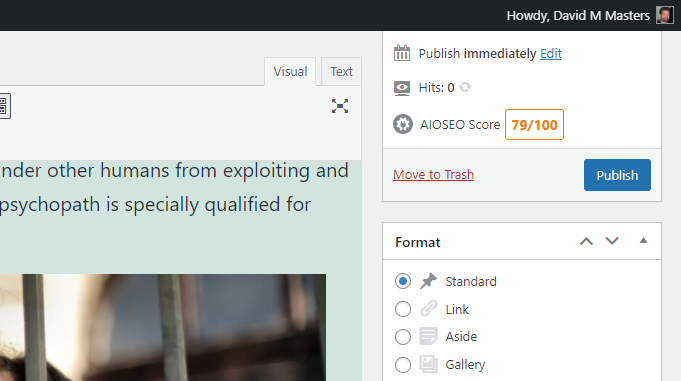
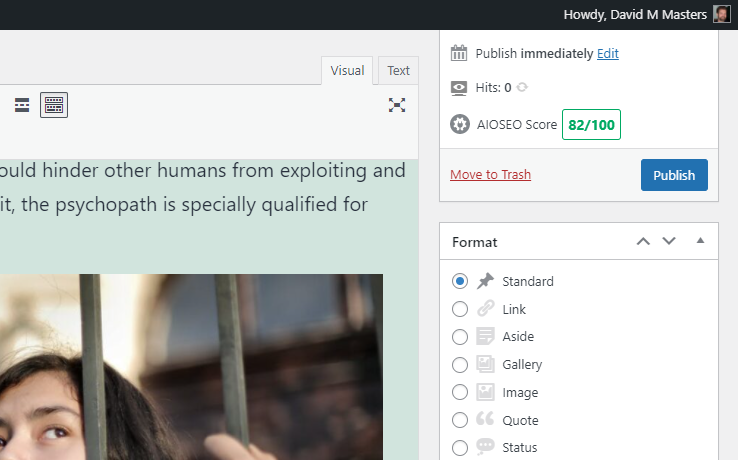
Okay, users of the All-in-One SEO plugin for WordPress often see this little indicator on the sidebar of their post editor entitled AIOSEO Score and it will give you a score of what appears to be your post’s current status and the ideal score of 100.

How to Raise Your AIOSEO Score in WordPress

Now, normally, if your All-in-One SEO plugin is left to run in the background, it will do most of the SEO handling of your post on autopilot, without much effort from you. But for those of you who desire to reach the heights of excellence and truly maximize every effort that you put forth (which these are the kinds of folks who are attracted to us and our work), then you don’t want to settle for less than 100%

So, for those of you who want to raise the bar for yourself, we will review what you can do to raise your AIOSEO Score.

Here’s a post that I am working on right now. Notice, this page is just text and look at the AIOSEO Scoreboard. It’s a whopping 56 out of 100.

What can you do to raise your AIOSEO Score in WordPress?

1. Insert Photo

The first thing I do is to insert a photo toward the top of the page, usually after the first paragraph. That way I don’t have to worry about where’s the right place to put the main photo.

You will have to locate an image that either you made or took the picture yourself, or you can find images online that are free to use.

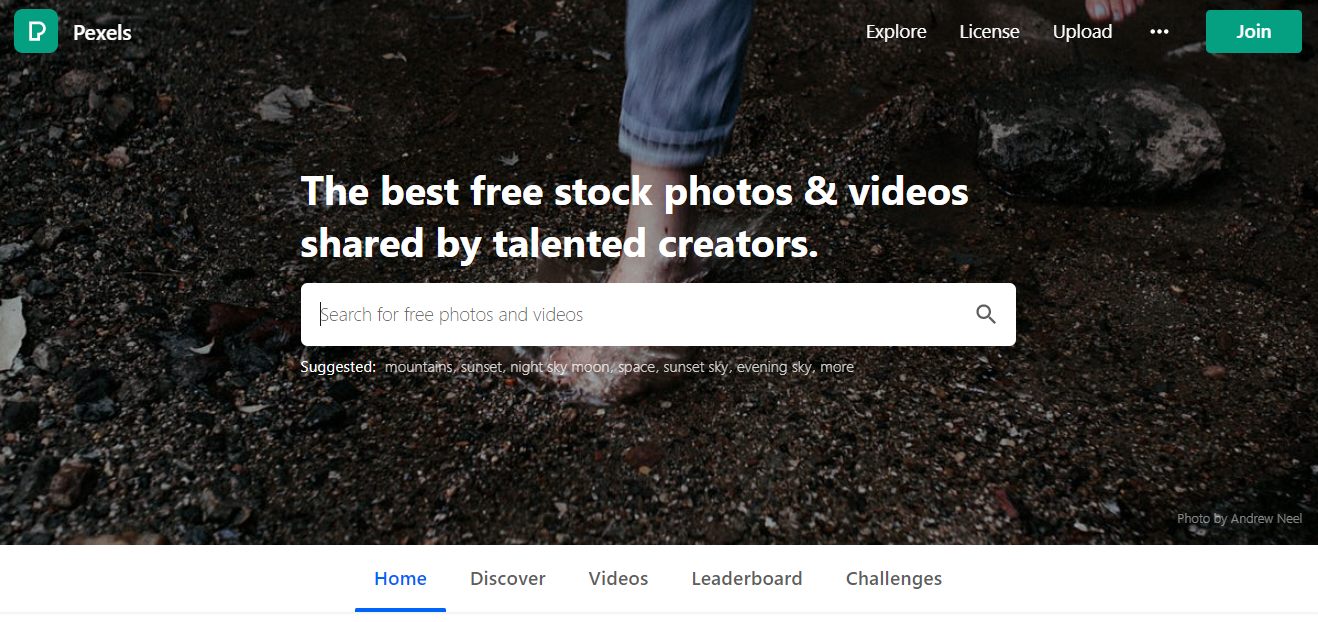
For this example, I will go to pexels.com and search for an image for this post.

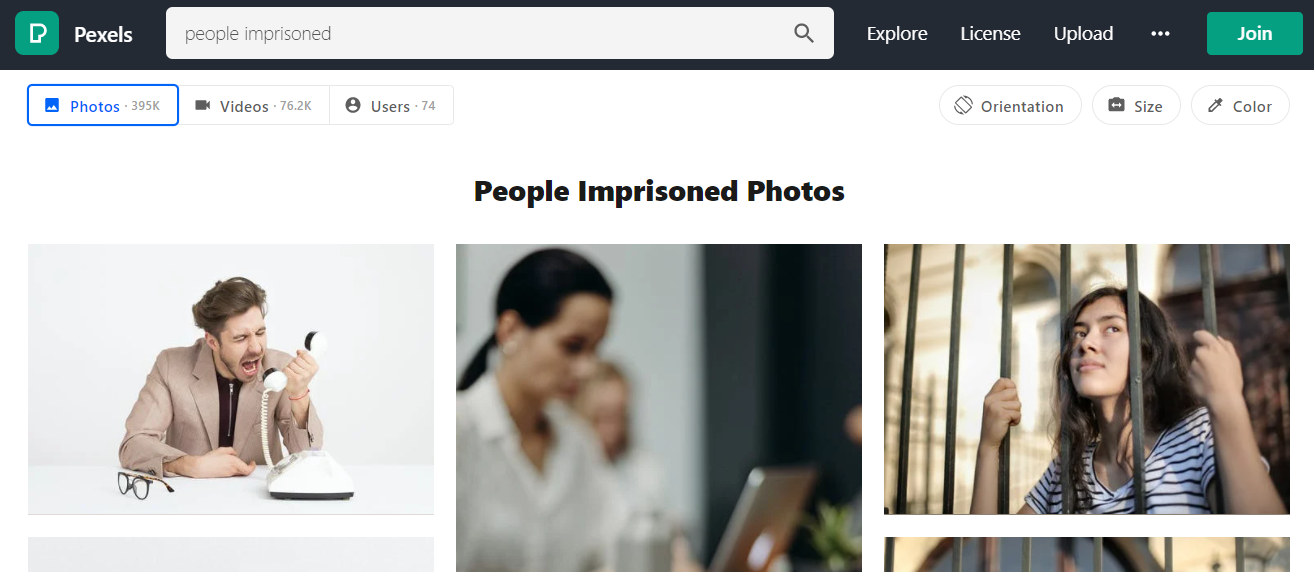
I just put in a search for something like “people imprisoned” and this one looks good. Then I go back to the post I’m working on and copy the title. Why? I’ll show you. I save the image to my hard drive as the title of the blog post. Like this.

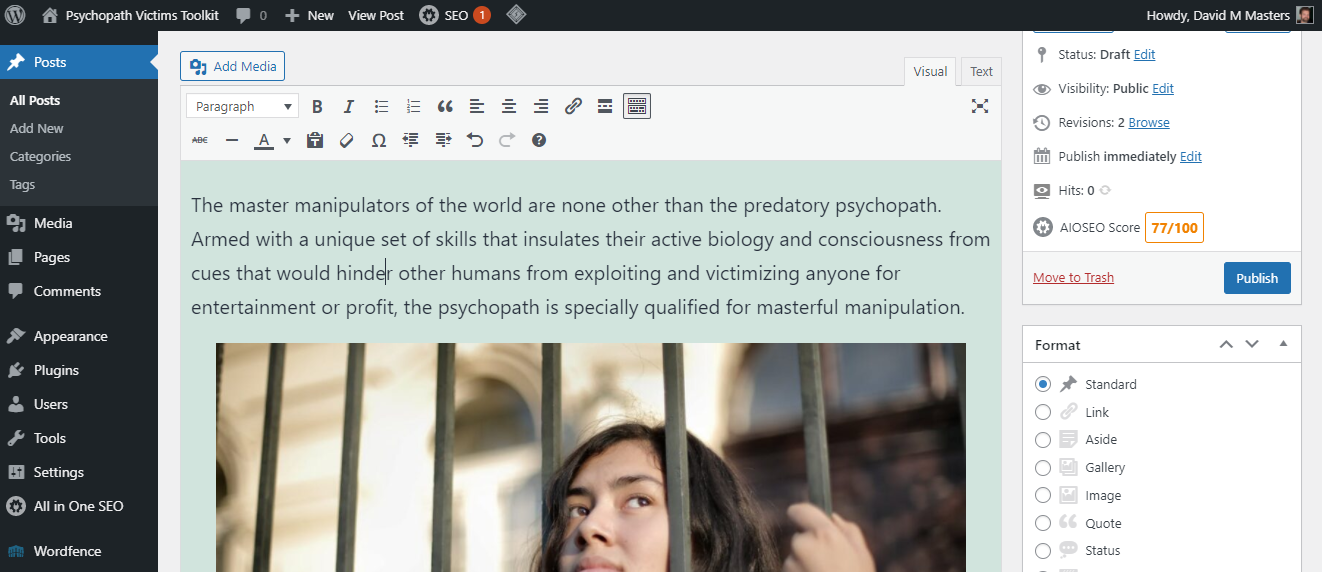
Then I go back to the post I am working on and click on “Add Media” and upload the image I just saved to my hard drive. And insert it after the first paragraph of my post. Oh, and looky there. I’ll be darned. My score went up to 77 from 56 just by doing that one thing. Not bad, ‘eh?

2. Check Keyphrase

Next, were going to ask All-in-One SEO what to do next. Before we do that, you want to select and copy your key phrase for this post. I’m going to use the title of the post for my key phrase.

Scroll down below your post until you find this: Focus keyphrase then paste and add your key phrase, and BAM!

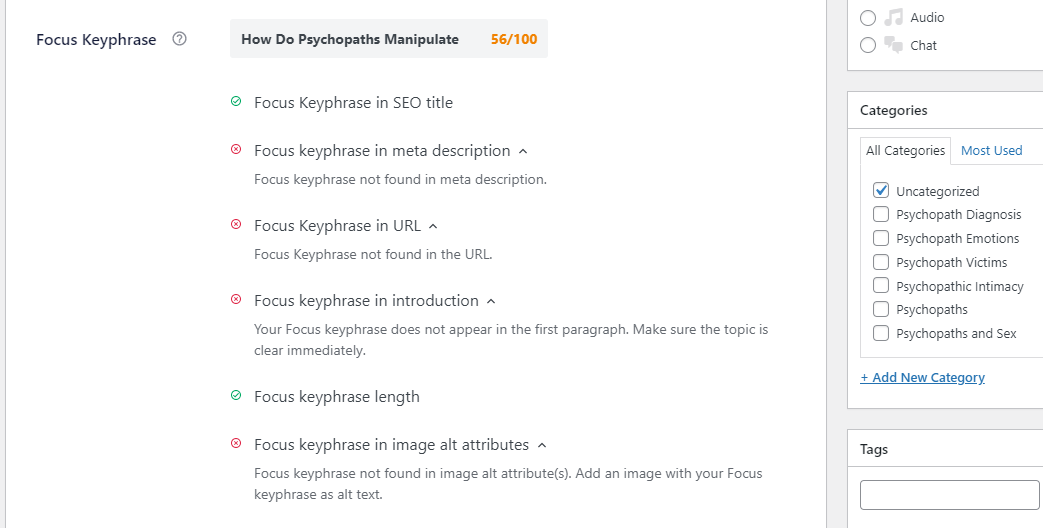
Here is your list of to dos to raise your AIOSEO score. For advanced users, that’s all you need. You can go get a cup of coffee or watch along while the rest of us go through this process one by one.

Okay, so I don’t have to deal with Focus Keyphrase in SEO title or Focus keyphrase length, so what do we have left?

3. Include Keyphrase in Opening Paragraph

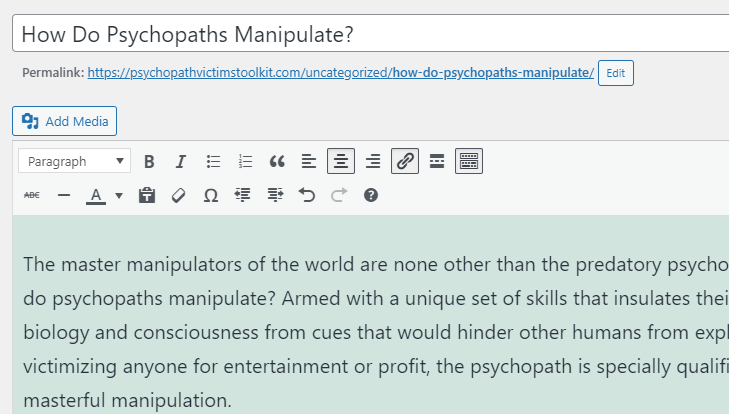
I know, let’s take a look at that opening paragraph, and I’m going to drop in the focus keyphrase in there and see where that gets us. I’ll save the draft and see what we’ve got. Checking the score, it looks like we picked up a couple of points going from 77 to 79.

4. Add Keyphrase to Alt Text in Main Image

Now, let’s scroll down to revisit our suggestions to see what it says now. Hmm, it says Focus keyphrase in image alt attributes. Focus keyphrase not found in image alt attribute(s). Add an image with your Focus keyphrase as alt text. Okay, that’s easy enough.

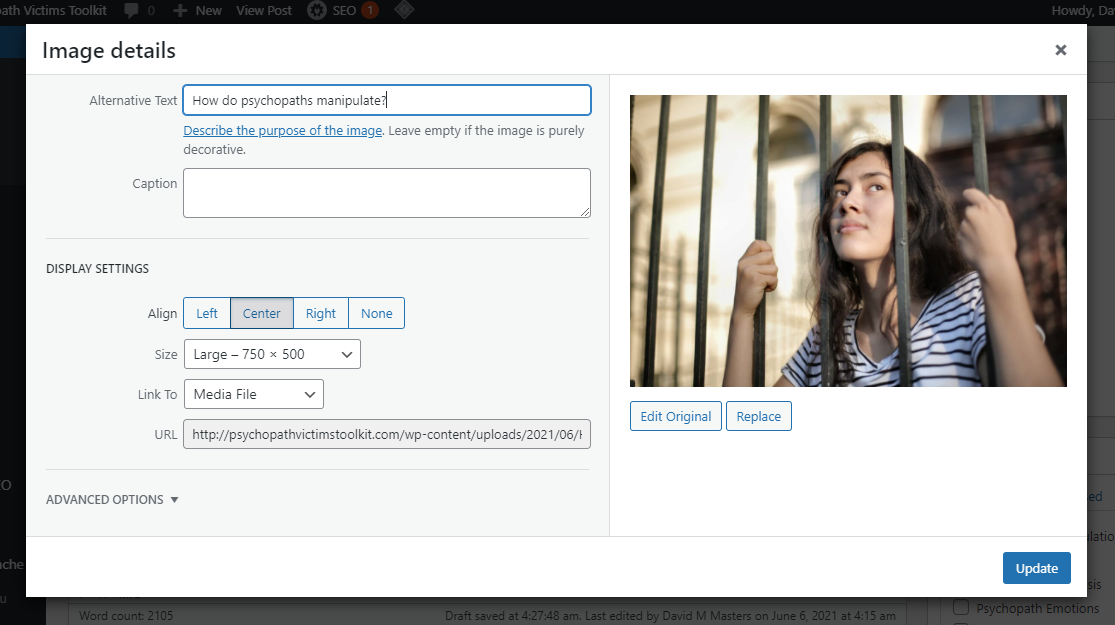
We are going to get back to that image and add our keyphrase to the Alternative text, like we were told, and see what happens. And it looks like that didn’t seem to help us in the score department because I am still at 79 out of 100. Let’s see what else they have down there.

5. Make Sure Keyphrase is in URL

It says Focus Keyphrase in URL that the Focus Keyphrase not found in the URL.

Hmm… that doesn’t sound right. So, let’s take another look at that. Looks like it’s in there to me. But I don’t like that “uncategorized” in the URL, so let’s fix that. I am going to give it a more meaningful category and unselect “uncategorized.” Save the draft and look at how we are doing.

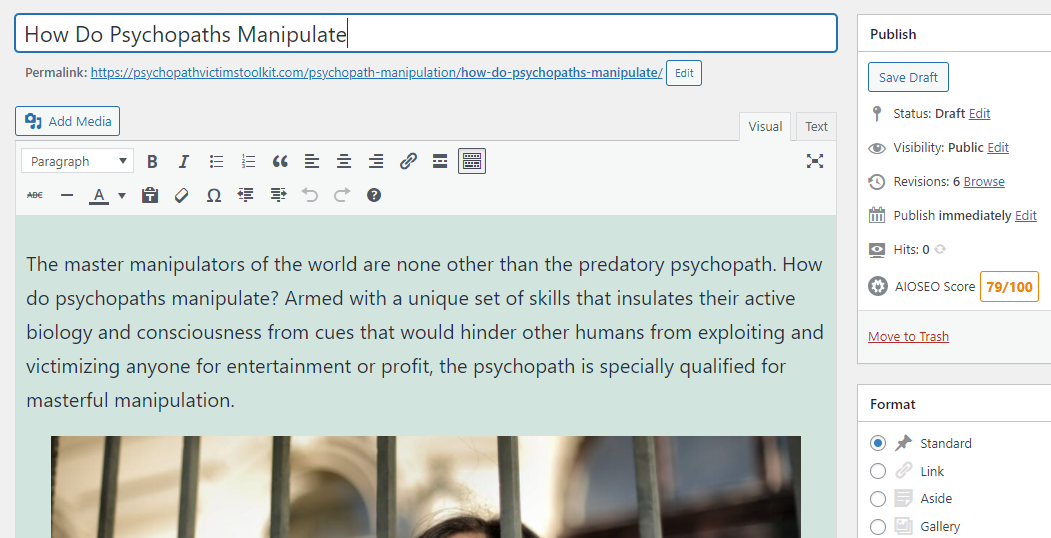
I like the URL better now that it has another alternative keyphrase in there, but that didn’t seem to do anything for our score, so how about if I take out that question mark in the title? Maybe that’s the ticket. Save the draft and oh, well looks like we’re in the same boat, so what’s next.

Scrolling down to the Focus Keyphrase is, you know where that is, now scroll down to the next section.

Here we have your Page Analysis with more ideas about how to raise your SEO score. Looks like everything is looking pretty good except for Focus Keyphrase in URL which we are going to ignore right now, leaving the Meta description length, which it says is over 160 characters, and External links, saying that I have no outbound links.

6. Edit Meta Description

Let’s take a look at those, starting with the meta description length.

I scroll up to just above the Focus Keyphrase section to find the Meta Description section, and I am going to copy and paste words from my first paragraph to seed this configuration with 160 words or less.

Save draft and see where we are. Alright, that got us into the green with a whopping 81 out of 100. Back to the Page Analysis to see what’s up there. There are still no external links, so let’s see what we can do about that.

7. Outbound Links

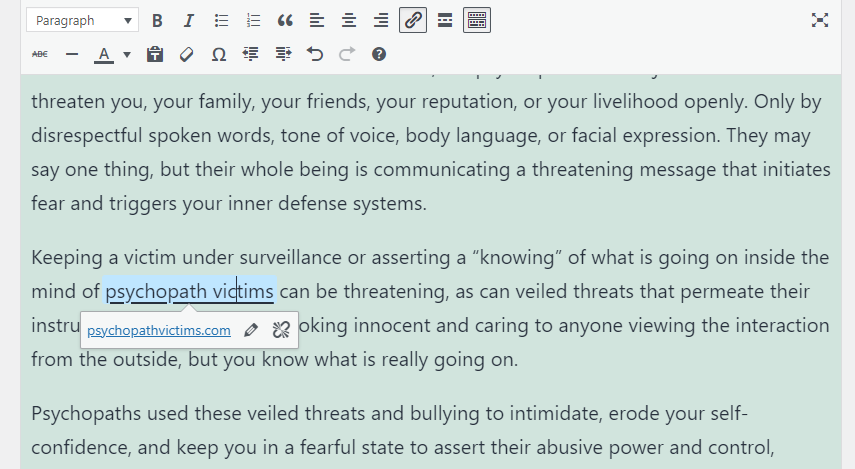
Here is a phrase I can link to another website, so I will link it here. Alternatively, I could link to a book, author page, study results, or even an Amazon product that could even be an affiliate pay link, so if someone clicks on it and buys something from Amazon, I earn a commission.

Bonus: Check Readability for How to Raise Your AIOSEO Score in WordPress

Save draft and check the score. 82 is a respectable score to expect a good result from the search engines, but if you want to do better, you can go back down to page analysis and click on Readability to see if there are any edit tweaks and changes to your text that can help you rank even better.

And here you can see I have a few suggestions to help this page rank even better.

It is not necessary to do all of this and jump through all these hoops for our purposes. Like I said at the outset, the automatic settings will get you there, but if you have the time, energy, and enthusiasm, you can really drill down and dial-in that score all the way to 100.

So, that’s it for today’s

How to Raise Your AIOSEO Score in WordPress

I’m David M Masters for St Paul’s Free University, and you can find out more about me at davidmmasters.com.